
Can Deep Learning Predict UK Train Delays?
What my dissertation taught me about trying to model one of rail’s hardest unsolved problems.
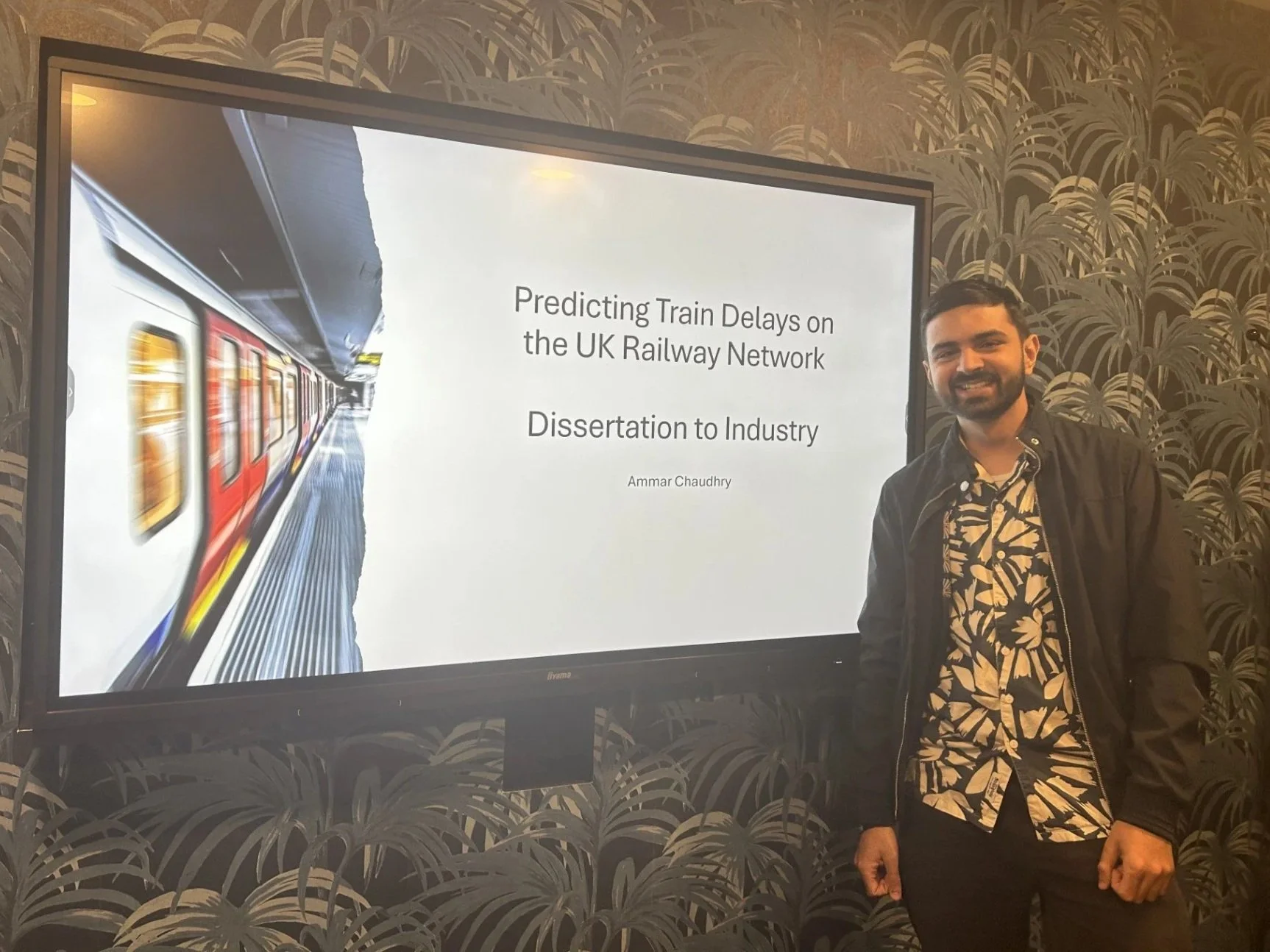
About Ammar:
As a Data Science Intern at Trackbase, I spend time looking at how tech can keep our railway networks moving. My dive into rail data started during my Computer Science degree at the University of Leicester. I wanted to see if machine learning could help tackle UK train delays, which became the focus of my dissertation (and ended up achieving a First).
At Trackbase, we run regular internal sessions called ‘Techbase,’ where team members share ideas, research, or interesting topics in the rail industry such as digital twins. I recently had the opportunity to present my own work: Predicting train delays using deep learning. Here is what my project found – and what it means for AI in rail.
UK Train Delays: A Real Problem Facing the Rail Industry
The motivation for this project came partly from my own lived experience as a passenger, and partly from a desire to understand what makes railways so incredibly hard to model.
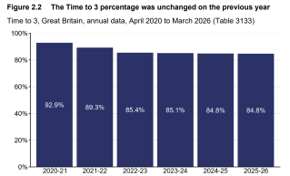
The practical case speaks for itself. Train delays in the UK are a persistent issue that has steadily worsened over the years. According to data from the Office of Rail and Road (ORR), the T3 punctuality metric - the percentage of stops arriving early or within three minutes of the schedule – is 84.8% nationally. But for a stricter one-minute threshold, that number drops significantly to 62.2%.
Make it stand out
Whatever it is, the way you tell your story online can make all the difference.
Make it stand out
Whatever it is, the way you tell your story online can make all the difference.
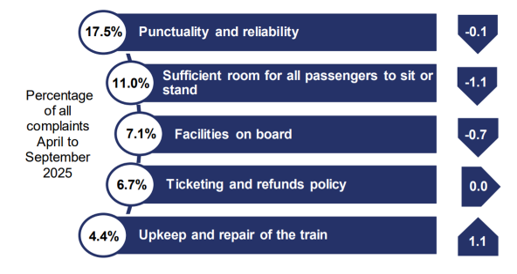
Passengers feel this acutely. ORR data shows that punctuality and reliability account for 17.5% of all passenger complaints between April and September 2025 – the biggest driver for public frustration with the railways.[1]
Building a Machine Learning Model for Rail Disruption
To keep the project manageable and focus on a network I knew well from university, I analysed specific services calling at Nottingham and Leicester, combining operational data from over 8,000 services with historical weather data to test whether layering environmental factors onto timetable data would improve model performance.
For the modelling itself, I used an LSTM (Long Short-Term Memory) network. LSTMs are a deep learning architecture designed to detect patterns in sequential data. Given that a train journey is inherently sequential, where what happens at Nottingham has a knock-on effect on every station down the line, it felt like the most natural fit.
“The model identified real patterns and produced accurate predictions for short-term delays. However, my honest takeaway was just how incredibly difficult this problem is to solve for the longer term. Predicting a train delay is not a simple forecasting task; it has a complex chain reaction. A five-minute delay caused by a jammed door at Nottingham ripples down the line, slowing down the train behind, and can cause another to miss its slot at a junction entirely. When you add sudden infrastructure failures like signal or points faults, you realise you are no longer modelling a timetable – you are trying to predict a chaotic chain reaction of human decisions and potential infrastructure failures. ”
The realities of deploying AI on the Railway
During our Techbase session, we discussed deploying AI in safety-critical environments, echoing several technical barriers highlighted in the UK rail industry's recent Artificial Intelligence in Rail Action Plan:
The Rare Stuff Matters Most: Major incidents or severe weather are the exact events a model sees the least in its training data. A system trained in normal operations is therefore poorly equipped to handle abnormal ones.
The Network Effect vs. LSTMs: LSTMs analyse individual train sequences and can’t inherently see the wider network topology. A delay on a separate line can cascade in ways an isolated model fails to capture.
Legacy Systems vs. Modern Data: As Martin Jones, Chief Engineer at Network Rail, notes: "Much of our railway operational data flows through distributed systems and legacy interfaces that weren't built for real-time analytics."[2]
Black Boxes vs. Trust: Controllers won’t reroute trains based on an AI recommendation that can’t be interrogated - they need clear governance and explain-ability. Without it, operators won't use it, or worse; they might fall into "automation bias," placing too much blind trust in outputs they cannot fully interpret.
Assurance and safety risks: AI introduces model drift and unpredictable behaviour under rare conditions. In a safety-critical environment with strict liability and safety mechanisms, rail adopts new technology cautiously – and rightly so.
What the Rail Industry needs to Get Right
Looking back, the best part of this project wasn't hitting a specific accuracy percentage. It was gaining a deeper understanding of how the railway works. Spending hours digging through real rail data and seeing how weather affects physical infrastructure showed me that you just can’t build an effective model without understanding the human and physical realities behind the data.
As we begin to see AI deployment in operational contexts, success won’t depend solely on machine learning capability and better models. In fact, we’ll also need better data infrastructure, clearer governance, and operational buy-in across different segments of the industry.
I’m incredibly grateful to everyone at Trackbase for their support and feedback throughout my internship.
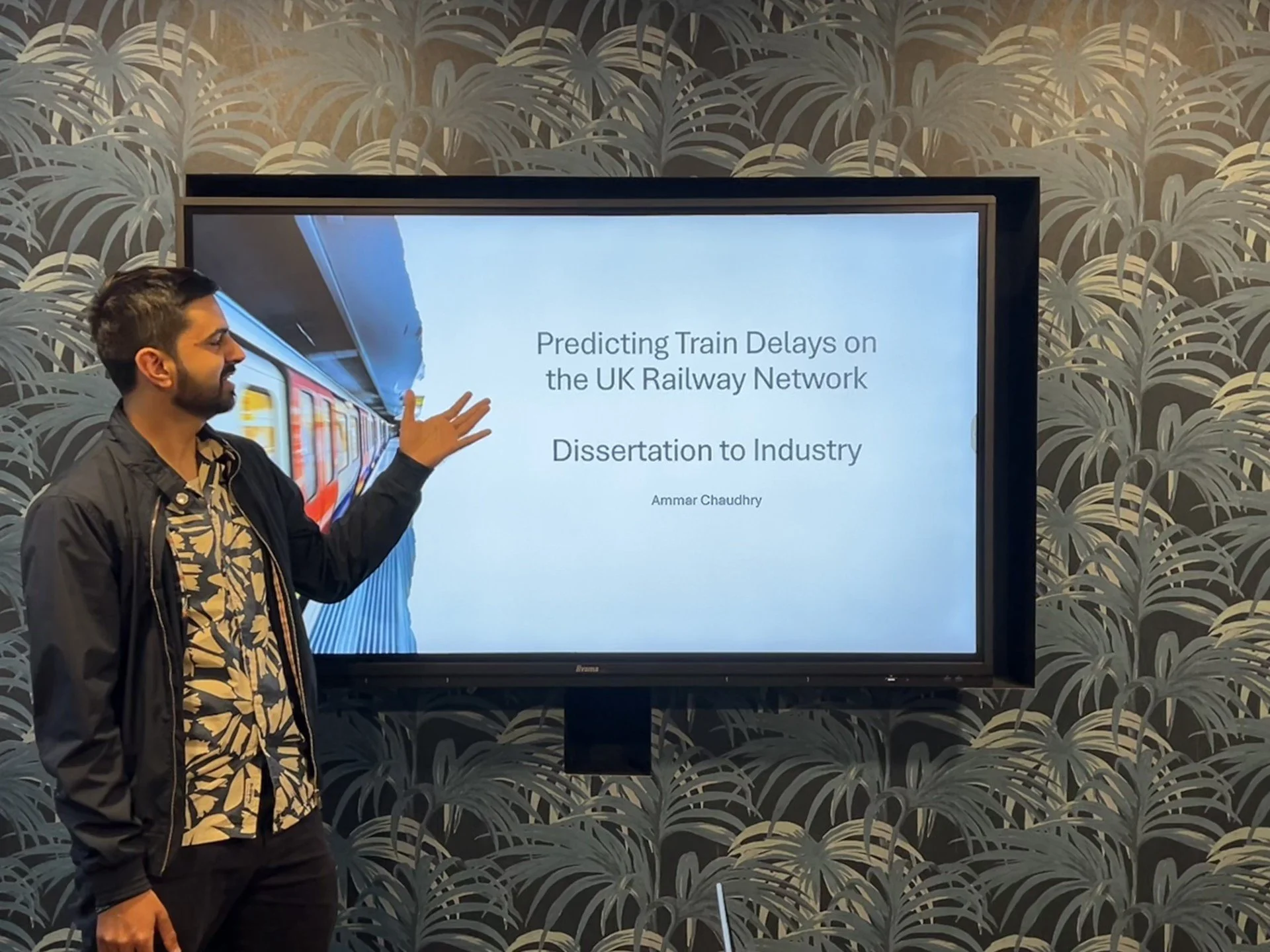
I’m incredibly grateful to everyone at Trackbase for their support and feedback throughout my internship.
Next up, I’m heading to the University of Nottingham for the Google DeepMind Research Ready Scheme, before moving to London to start my MSc in AI for Sustainable Development at UCL.
References:
[1] Office of Rail and Road. (2026, February 5). Passenger rail service complaints, April to September 2025. ORR Data Portal. https://dataportal.orr.gov.uk/statistics/passenger-experience/passenger-rail-service-complaints/
[2] GBRX. (2026). Artificial Intelligence in rail: The industry action plan (Section 3: Barriers and challenges, p. 31). Great British Railways Strategic Technology Body. Launched at the Science Museum, London, April 28, 2026.